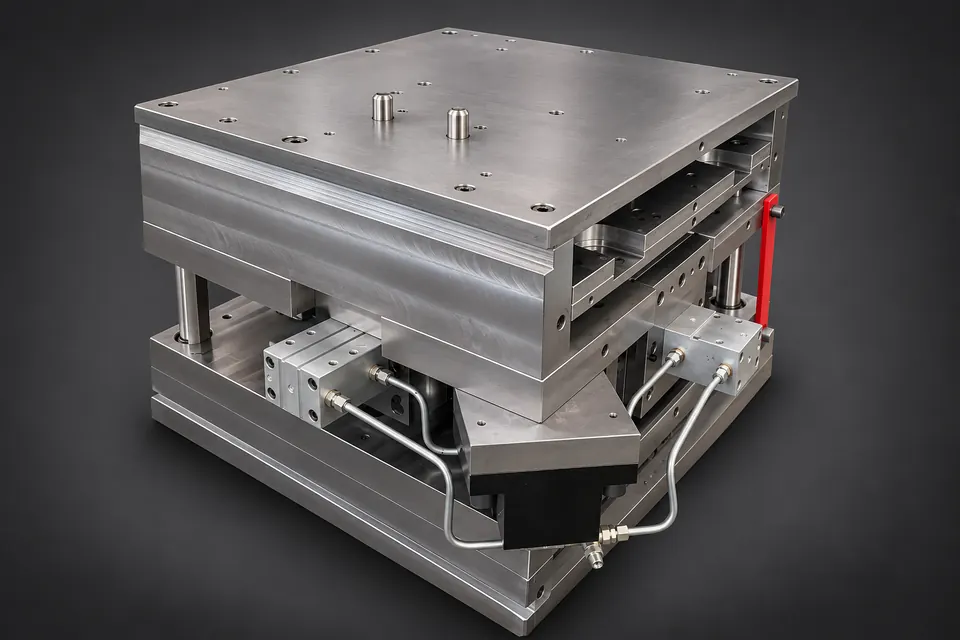
In high-pressure die casting, molten metal is injected at high speed and high pressure into a closed steel die made of two halves. For aluminium the pressure is normally between 300 and 1,200 bar: the metal enters the cavity at tens of metres per second and fills it in a few hundredths of a second. The pressure is held while the casting solidifies; then the die opens and the ejector pins push it out.
It is the most productive foundry process: it allows thin walls, good tolerances, surfaces ready for finishing and near-net-shape parts that need little machining.
Zamak is cast on hot-chamber machines, where the injection unit is immersed in the molten metal. Aluminium and brass are cast on cold-chamber machines, where the metal is ladled into the shot sleeve for every shot.
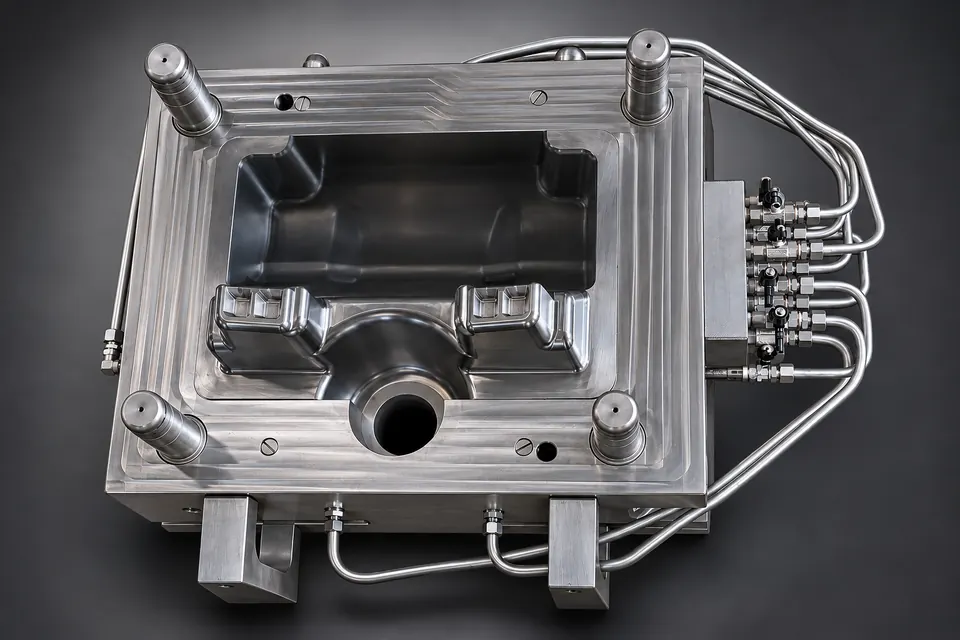
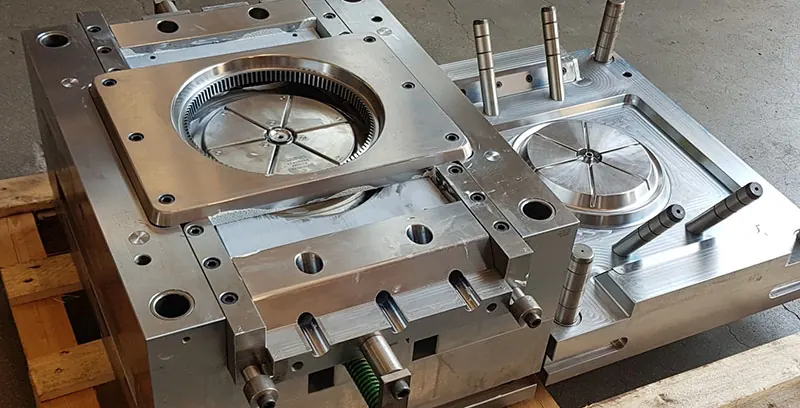
A die for zamak: the two open halves.
What a die casting die is made of
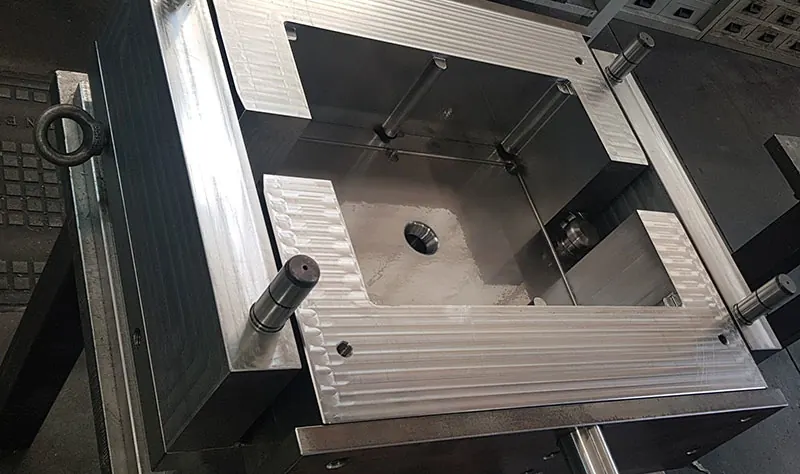
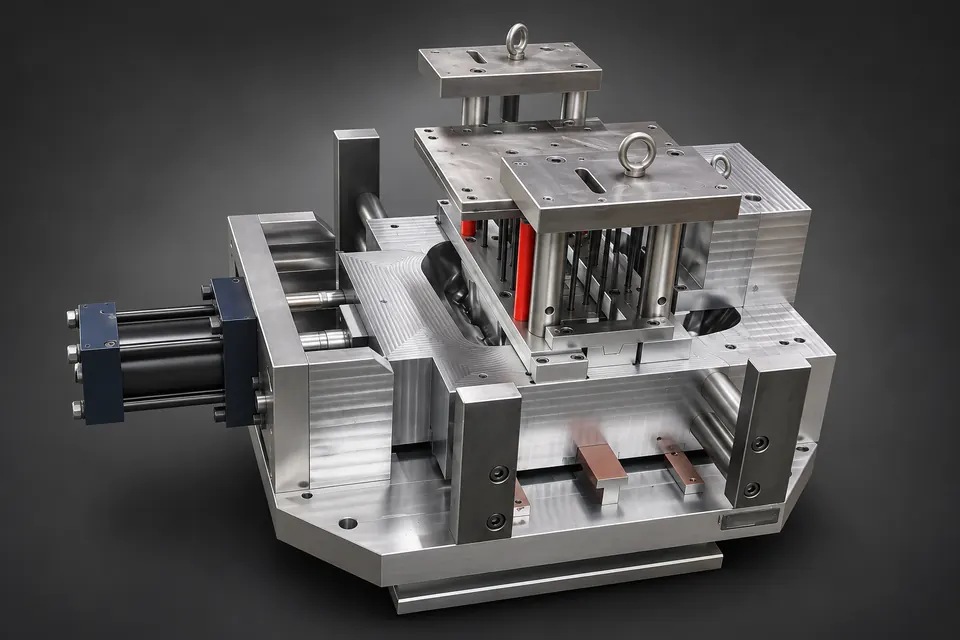
A die casting die (also called a die casting mould or tool) is an assembly of precision parts that work at very high temperatures and pressures on every shot. We design it together with the casting:
the cavity inserts, which give the part its shape, in the fixed and moving halves;
the slides, the moving side parts that form undercuts and cross holes;
the ejector pins, which push the casting out when the die opens;
the runners, overflows and vents, which feed the metal and let air and gases escape;
thermal control, with the channels that keep the die at the right temperature;
the chill vent, the block with corrugated faces that lets air out and stops the metal;
vacuum, when the casting needs less porosity: if it is to be heat treated or welded, must be pressure-tight or is a structural part.
Die casting dies are made from hot-work tool steels, and their life depends heavily on the alloy: roughly millions of shots for zamak, hundreds of thousands for aluminium and tens of thousands for brass, which enters the die at much higher temperatures.
When to choose high-pressure die casting
High-pressure die casting pays off for large series, thin-walled parts and complex geometries, when productivity and repeatability matter. Machine and die cost more than in other processes and pay for themselves over the number of parts.
Sand cores cannot be used in high-pressure die casting, and a standard casting always has some porosity. For parts with complex internal cavities, heavier sections or that must be heat treated, it is often worth considering low-pressure die casting or gravity die casting. We are happy to discuss it before designing the die.
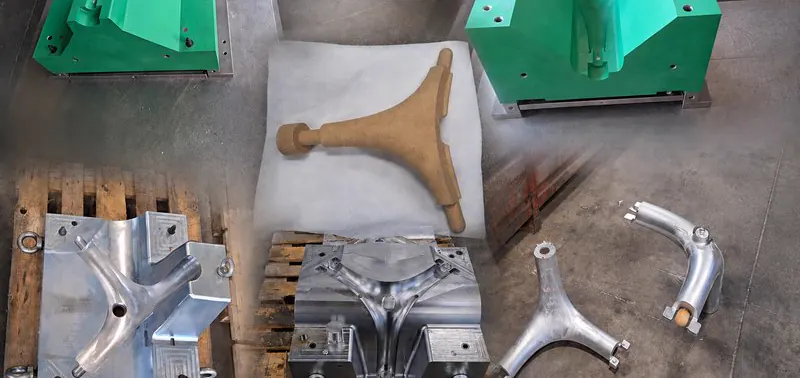
Projects: high-pressure die casting dies
Frequently asked questions
Which alloys can be cast with your dies?
We build dies for high-pressure die casting of aluminium, brass and zamak, the zinc alloy used in zinc die casting.
What do you need for a quote?
The 2D drawing or, better, the 3D model of the part, the alloy, the expected quantities and, if you already know it, the machine the die will run on.
Do you also run filling simulations?
Yes: filling simulation is one of the services of our engineering department, for both die casting and plastic injection moulding.
Vacuum or chill vent?
In general a chill vent is enough for castings where some porosity is acceptable; vacuum is needed when the part is to be heat treated or welded, must be pressure-tight or is structural. A chill vent is often used to close the vacuum circuit as well. We will cover it soon in an article in our News section.
How long does a die casting die last?
It depends mainly on the alloy: roughly millions of shots for zamak, hundreds of thousands for aluminium, tens of thousands for brass. Design, steel, heat treatment and maintenance matter too.