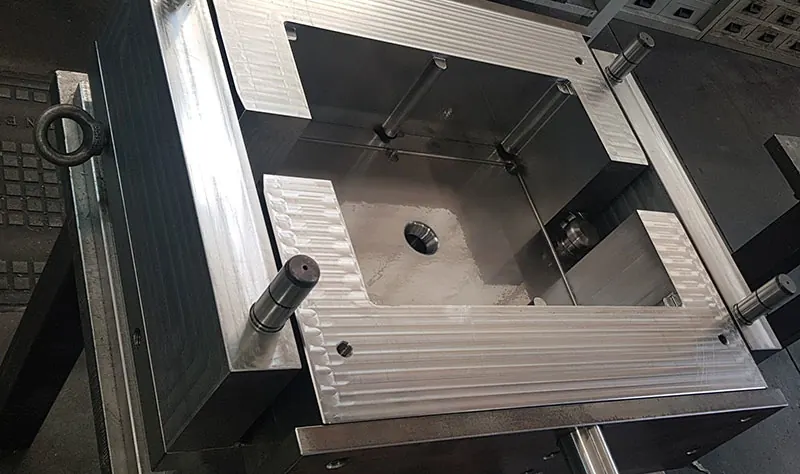
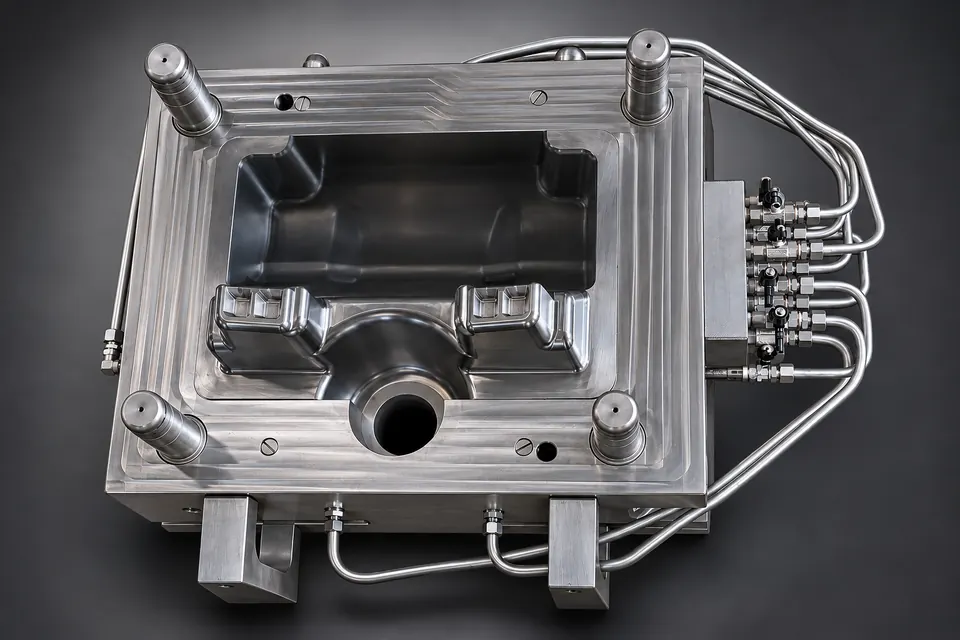
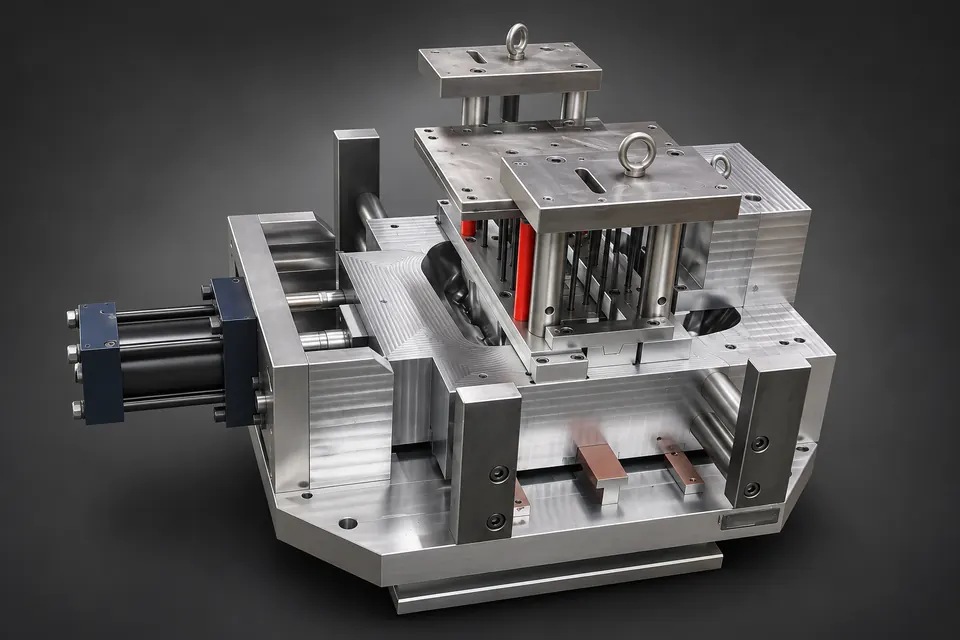
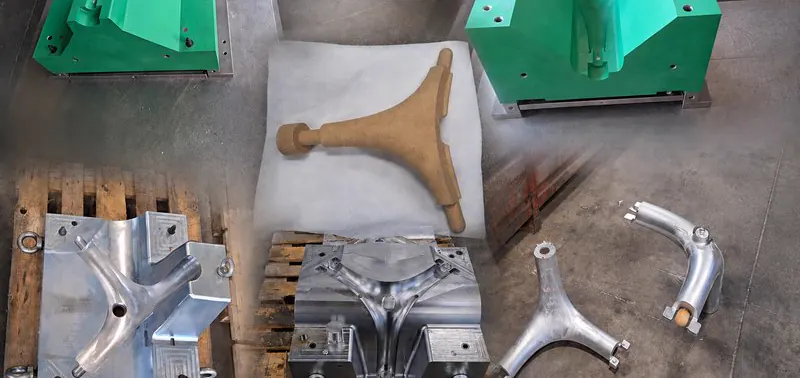
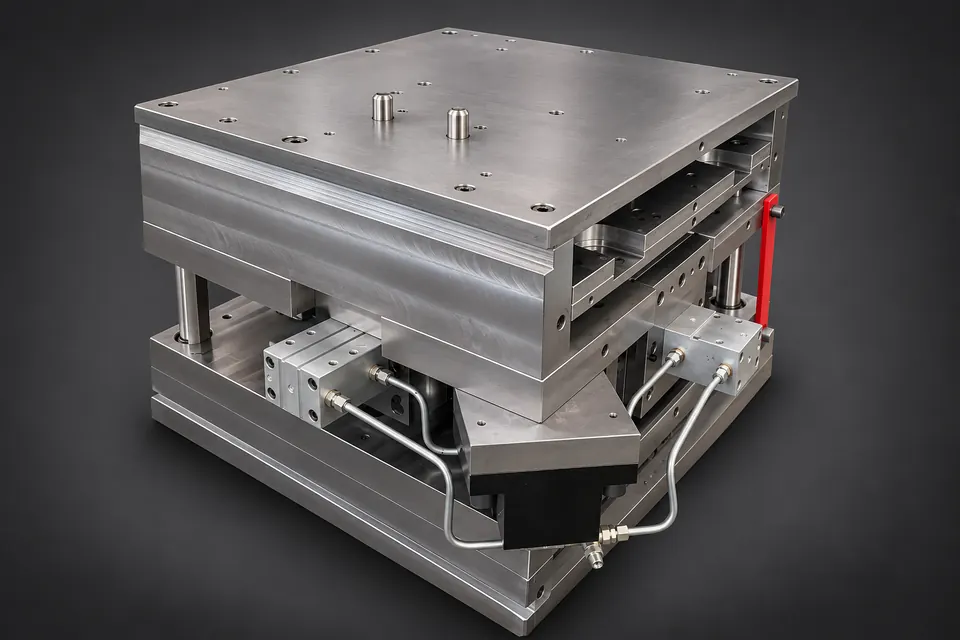
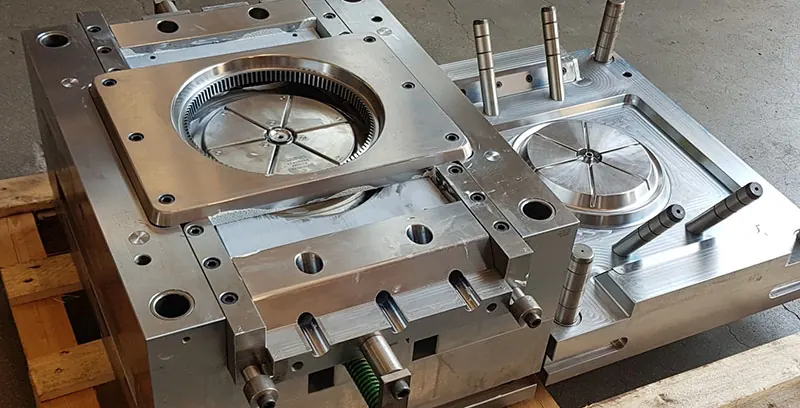
More and more customers choose low-pressure die casting for the high mechanical properties of the finished product. Promega designs, optimises and builds the dies and core boxes for each specific part.
Alloy
Aluminium.
Castings
Slow, controlled filling: sound castings, suitable for heat treatment too.
Cores
We also design the core boxes for internal cavities.
Design
2D and 3D CAD-CAM, feasibility study and simulation.
How low-pressure die casting works
In low-pressure die casting the die sits above a sealed holding furnace. Gentle air pressure on the surface of the melt pushes the molten aluminium upwards through a riser tube into the die. The process works below 1 bar, about a thousand times less than high-pressure die casting. The pressure is held until the casting has solidified; then it is released and the metal left in the tube flows back into the furnace.
Filling is slow, from below and without turbulence, and the riser tube draws from the bottom of the bath, where the metal is cleanest: that is why castings come out sound, with few inclusions, and can be heat treated. Feeders are often unnecessary, and metal yield is often above 85-90%.
What it is used for
In general, low-pressure die casting is the classic choice for aluminium castings of medium complexity in medium series, where pressure tightness and strength matter. Its typical applications are:
alloy wheels, the most common application;
engine blocks and cylinder heads;
pump housings and suspension parts;
frames, subframes and electric motor housings, including for electric vehicles: sand cores make hollow, lighter parts possible.
Low pressure, gravity or high pressure?
Compared with high-pressure die casting, machine and die cost less, sand cores can be used and the casting is sounder; on the other hand the cycle is slower and walls are thicker, around 3 mm. Compared with gravity die casting, filling is more controlled, mechanical properties are slightly better and less metal is wasted.
The choice depends on the part, the quantity and what it has to withstand: assessing it together before designing the die is the first step.
Frequently asked questions
Which alloys do you build low-pressure dies for?
For aluminium.
What pressure is used in low-pressure die casting?
Less than 1 bar: usually a few tenths of a bar during filling, up to about 1 bar at the end to compact the casting.
Do you also design the cores?
Yes: we design and build the core boxes that form the sand cores for the internal cavities of the casting.
What do you need for a quote?
The 2D drawing or 3D model of the casting, the alloy, the expected quantities and the machine the die will run on.