
Machining ·
Wire EDM or die-sinking EDM: differences and when to choose each
Two electrical discharge machining processes, two different ways of machining hardened steel. Here is how they work and when we use one or the other.
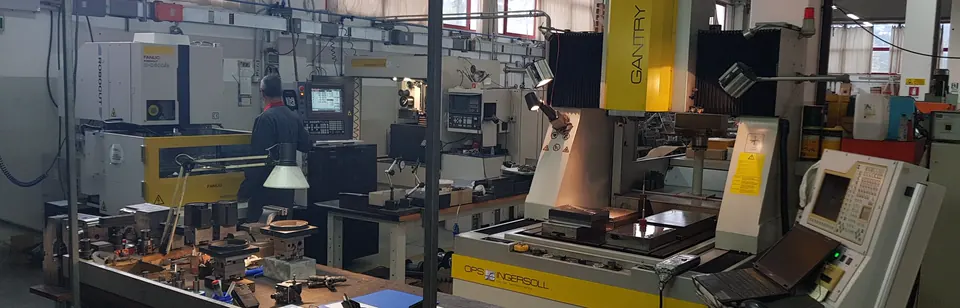
What EDM is
Electrical discharge machining (EDM) removes material with a series of electrical sparks between an electrode and the workpiece, both immersed in an insulating fluid. There is no contact and no cutting force: that is why it works well on hardened steels and delicate geometries. It works on any electrically conductive material.
Wire EDM
In wire EDM the electrode is a thin wire, usually brass, that runs continuously from a spool through the workpiece, immersed in deionised water, and cuts right through it like a CNC-guided saw. The wire guides can move relative to each other to produce tapered walls.
It is the choice for through profiles and precise contours, even in thick plates: punches and dies, inserts, slots. An internal profile needs a start hole first, for the wire to pass through.
Die-sinking EDM
In die-sinking EDM the electrode has the shape of the cavity to be produced, in negative, and the machine sinks it into the workpiece, immersed in dielectric oil, as the material erodes. Electrodes are made of graphite or copper: often a graphite one for roughing and a copper one for finishing.
It is the process for blind cavities: thin, deep ribs, sharp internal corners, lettering and textures in the die cavities, where a milling cutter cannot reach. The extra cost is the time needed to make the electrodes.
The differences at a glance
| Wire EDM | Die-sinking EDM | |
|---|---|---|
| Electrode | Thin wire, usually brass | Shaped graphite or copper electrode |
| Fluid | Deionised water | Dielectric oil |
| Geometries | Through profiles, including tapers | Blind cavities, ribs, sharp corners |
| Typical uses in a die | Inserts, dies, punches, seats | Cavities, deep ribs, lettering and textures |
| Before machining | A start hole for internal profiles | Making the electrodes |
Which one we choose
Often neither: where a milling cutter can reach, milling is faster. EDM comes in where milling is not enough, and a die casting die or a plastic mould usually needs both: wire EDM to cut inserts and seats, die-sinking EDM for the parts of the cavity that the cutter cannot reach.
In our workshop we work with both die-sinking and wire EDM: if you have a part and are not sure which is the best way, ask us.